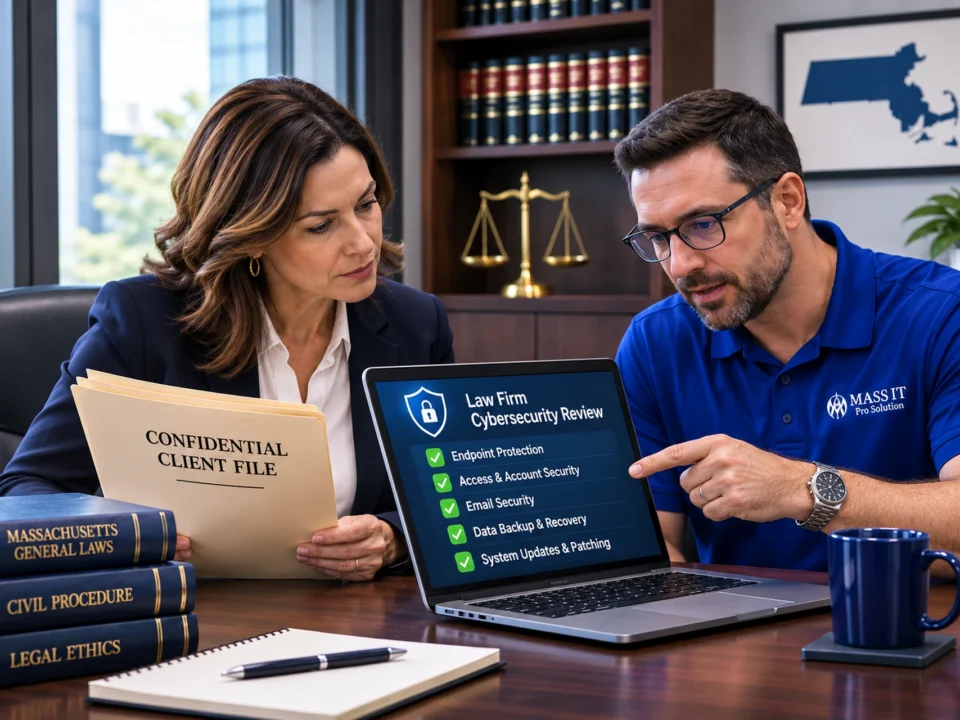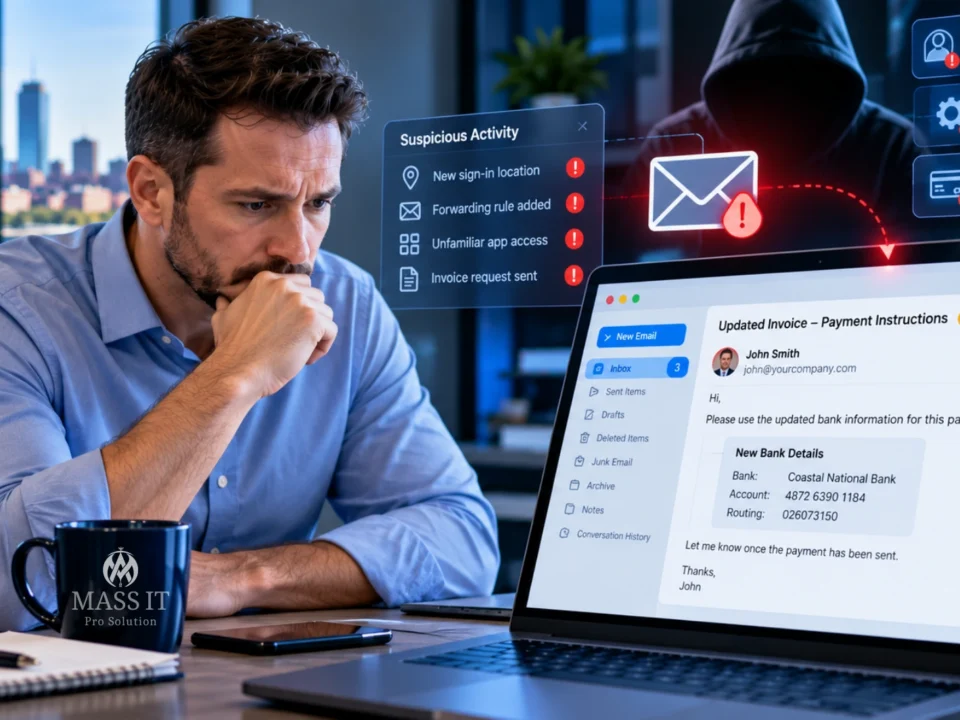

Your business pays a managed IT company to protect its computers, email, network, and sensitive information. The provider tells you it carries cyber insurance. That sounds reassuring.
But here’s the question many business owners never think to ask: If your company suffers a cyberattack tomorrow, whose insurance is actually going to cover the loss?
The answer might surprise you.
Your managed IT provider’s cyber insurance does not automatically extend to your business. And even if the provider has professional liability insurance, that does not mean every ransomware attack, data breach, email compromise, or financial loss becomes their responsibility.
For Massachusetts businesses, particularly law firms, medical practices, dental offices, accounting firms, and other organizations handling confidential information, understanding this distinction matters.
You need to know what your IT provider is responsible for, what insurance your own business carries, and what happens when an incident involves both parties.
Does Your IT Provider’s Cyber Insurance Cover Your Business?
No. A managed IT provider’s cyber insurance generally covers the provider’s own insured risks, not every loss suffered by its clients.
A business typically needs to arrange its own cyber insurance to obtain coverage for its own eligible cyber-related losses and liabilities. The provider may carry separate Technology Errors and Omissions (Tech E&O) insurance to address claims involving mistakes or failures in professional technology services.
There is an important distinction, however. If a managed IT provider makes an error that causes a client financial harm, the provider’s applicable liability insurance might respond to a valid claim. That depends on the circumstances, legal responsibility, and actual insurance policy.
The key point: your IT provider having insurance is not the same thing as your business being insured.
The Federal Trade Commission’s cybersecurity insurance guidance explains that businesses should evaluate both first-party and third-party coverage based on their specific risks.
The Three Types of Insurance Every Business Owner Should Understand
The confusion usually starts because people use the phrase “cyber insurance” to describe several different types of financial protection.
Although policies can combine different coverages, their purposes are not identical.
1. Cyber Insurance for Your Business
This is coverage purchased by your organization to address certain losses and liabilities resulting from covered cyber incidents.
Depending on the policy, it may help with:
- Investigating a ransomware attack or data breach.
- Recovering compromised or damaged data.
- Paying for covered business interruption losses.
- Hiring approved forensic investigators and legal counsel.
- Notifying affected individuals after a covered breach.
- Responding to certain claims involving exposed customer information.
- Addressing covered cyber extortion or fraudulent activity.
Some of these costs fall under first-party cyber coverage, which addresses losses directly experienced by the insured business.
Other expenses may fall under third-party cyber liability coverage, which addresses qualifying claims brought against the insured business.
These protections may be included together or offered through separate policies or endorsements. Limits, deductibles, exclusions, and eligibility requirements differ.
For example, a law firm that cannot access its case management software after ransomware may face financial losses even if no client files were stolen.
Whether its policy covers the interruption depends on the language governing business interruption, the cause of the outage, applicable waiting periods, and other conditions.
2. Cyber Insurance for Your Managed IT Provider
A managed IT provider faces its own cybersecurity risks.
The provider may have administrative access to customer networks, Microsoft 365 environments, remote management platforms, backup systems, and other critical infrastructure.
If attackers compromise the provider’s own systems, the provider may experience costs involving forensic investigation, restoration, interruption of operations, and potential third-party claims.
The provider’s own cyber insurance may address covered losses and liabilities arising from those incidents.
But imagine your law firm’s employee opens a phishing email, the firm’s Microsoft 365 account is compromised, and confidential files are exposed.
The fact that your IT provider carries cyber insurance does not automatically mean the provider’s insurer will pay your law firm’s investigation costs or resulting business losses.
Your firm needs to evaluate its own cyber coverage and the facts surrounding the incident.
3. Technology Errors and Omissions Insurance (Tech E&O)
Tech E&O insurance is particularly relevant when evaluating a managed IT company.
It is professional liability insurance designed to address certain claims alleging that a technology provider’s services or products caused financial harm because of an error, omission, or failure to perform as required.
Consider a hypothetical situation.
A managed IT provider is contractually responsible for maintaining a client’s backup system. Because of an alleged negligent configuration or failure to perform required maintenance, the client discovers during an outage that essential data cannot be restored.
The business suffers a financial loss and brings a claim against the provider.
The provider’s Tech E&O insurance may respond to a covered professional negligence claim.
However, whether the insurer defends the claim or pays damages depends on the policy, the service agreement, applicable law, and the facts established.
Not every failed backup or unsuccessful recovery constitutes negligence.
Not every professional mistake is insured.
And Tech E&O coverage should not be confused with the client’s own cyber insurance.
Insurance broker Lockton’s explanation of technology E&O coverage describes this distinction between liability arising from professional technology services and cyber-related losses.
What Happens When a Cyberattack Occurs? Three Different Scenarios
The best way to understand the difference is to examine who experienced the loss, what caused it, and which insurance policy might respond.
Scenario One: A Law Firm Employee Falls for a Phishing Email
Imagine a Massachusetts law firm with 12 employees.
An attorney receives a convincing email impersonating a trusted client. The attorney enters their login credentials into a fraudulent website.
The attacker gains access to the firm’s Microsoft 365 account and attempts to download confidential documents.
The firm discovers the compromise and needs to investigate whether information was accessed or disclosed.
Who is responsible?
The incident does not automatically establish that the IT provider made a mistake. The investigation should determine what controls were in place, what services were contracted, whether the provider fulfilled its responsibilities, and how the attacker gained access.
The firm’s own cyber insurance may provide applicable incident response or liability coverage.
If the provider failed to perform a specifically contracted security service, that could introduce a separate question about the provider’s responsibility.
But the provider’s insurance is not automatically a substitute for the law firm’s coverage.
The lesson: A third-party IT relationship does not eliminate your organization’s exposure to phishing, account takeover, or compromised client information.
Scenario Two: The IT Provider Makes a Configuration Error
Now consider an accounting practice that hires an MSP to configure its firewall, remote access, and security controls.
Suppose a technician negligently changes a required security setting, contrary to the agreed scope, and that misconfiguration contributes to a security incident.
The accounting firm experiences an outage, investigation expenses, and possible data exposure.
This introduces two separate questions.
First, does the accounting firm’s own cyber insurance cover any of its resulting losses?
Second, did the IT provider breach a contractual or professional duty, and could its Tech E&O or other applicable liability insurance respond to a claim?
Both insurance policies may need to be evaluated. Their involvement does not mean both will pay, nor that the total loss is automatically recoverable.
The provider’s insurer may investigate the allegation, contest liability, apply exclusions, or resolve a covered claim.
The client’s insurer may also have rights to pursue recovery from a responsible third party, depending on the policy and law.
The lesson: A provider can potentially be held responsible for negligent work without the client automatically becoming insured under that provider’s policy.
Scenario Three: A Healthcare Practice Is Hit by Ransomware
A medical office depends on its electronic health records, scheduling systems, billing applications, and patient communications.
A ransomware incident disrupts access to these systems.
Even if the office uses a managed IT provider, it may need emergency technical recovery, legal assessment, business continuity arrangements, and potentially a regulatory response.
Its own cyber policy may provide certain covered recovery and interruption benefits.
Its IT provider may assist with incident containment, investigation, restoration, and coordination with the insurer’s approved vendors, depending on the service agreement.
The practice must also evaluate applicable HIPAA and other legal obligations.
The lesson: An IT provider can help prevent, detect, and respond to incidents, but buying managed IT services does not transfer the practice’s entire operational and regulatory risk to that provider.
These are hypothetical examples, not actual client incidents or guarantees of insurance outcomes.
What If Your Managed IT Company Doesn’t Carry Cyber Insurance?
This is another question business owners should ask before signing a managed services agreement.
A provider without appropriate insurance may still perform technically competent work. Insurance status alone does not establish technical capability.
But the absence of relevant insurance can create additional financial and contractual risk.
Imagine a provider makes a serious professional mistake that results in a substantial claim. If that provider lacks applicable liability insurance, there may be no insurer available to fund its defense or covered settlement.
Whether the client can recover losses would depend on contractual rights, legal liability, and the provider’s ability to pay.
A business should therefore evaluate both:
The provider’s financial risk protection: Does the company maintain insurance appropriate for the work it performs, including Technology E&O and relevant cyber liability coverage?
The provider’s actual security practices: Does it maintain appropriate access controls, incident response procedures, endpoint security, backup practices, change management, and monitoring?
An insurance certificate does not establish that a provider’s systems are secure.
Likewise, strong technical expertise does not replace the need for appropriate financial risk management.
Ask Your IT Provider for Proof, Not Just Reassurance
A Certificate of Insurance (COI) can help establish what policies a provider reports carrying, including policy periods and coverage limits.
But a certificate is not the complete insurance contract.
Being listed as a certificate holder generally does not make your business an additional insured. Any additional-insured rights must be supported by the applicable policy terms or endorsements, where available.
For significant engagements, have your insurance advisor or legal counsel review the provider’s actual coverage requirements alongside the managed services agreement.
The goal is not to make every vendor guarantee every possible loss.
It is to understand where responsibility begins, where it ends, and whether the appropriate coverage exists.
Does Your Massachusetts Business Need Its Own Cyber Insurance?
For many Massachusetts organizations that depend on electronic records, cloud services, online payments, or confidential customer information, cyber insurance is worth evaluating with a qualified insurance professional.
The need is not determined solely by company size.
A small legal practice may hold confidential communications and sensitive personal information.
A medical office may rely on critical patient systems and electronic protected health information.
An accounting practice may possess Social Security numbers, tax returns, payroll records, and banking details.
A business does not need hundreds of employees to experience a significant interruption.
Cyber insurance can provide a financial risk-transfer mechanism for specified losses, but it does not replace preventive cybersecurity controls.
The National Association of Insurance Commissioners emphasizes that policyholders should review coverage terms, limits, exclusions, required security practices, incident reporting requirements, and the relationship between cyber and other insurance policies.
First-Party and Third-Party Coverage Are Not the Same
A business should understand whether it has both types of protection.
| Coverage | What it generally addresses |
|---|---|
| First-party cyber | Certain covered losses the insured business experiences directly, such as incident response, restoration, and interruption |
| Third-party cyber liability | Certain covered claims made against the insured business by customers, clients, or others |
| Technology E&O | Certain claims arising from errors or omissions in professional technology products or services |
| Crime or social engineering coverage | Certain covered financial theft and fraud losses, depending on the separate policy or endorsement |
A business can carry cyber insurance and still have gaps.
For instance, a policy covering data restoration might not provide the same protection for a fraudulent wire transfer, prolonged interruption at a third-party cloud provider, or certain regulatory expenses.
Those exposures require specific review.
Ask your broker what is actually included rather than assuming the word “cyber” means every possible incident is covered.
What Massachusetts Law Says About Protecting Customer Information
Insurance and cybersecurity compliance are separate issues.
Massachusetts businesses may have legal duties to protect personal information regardless of whether they purchase cyber insurance or outsource IT management.
201 CMR 17.00: Massachusetts Data Security Requirements
Massachusetts regulation 201 CMR 17.00 establishes information-security requirements for organizations that own or license covered personal information about Massachusetts residents.
The regulation requires an appropriate written information security program, commonly called a WISP, with administrative, technical, and physical safeguards.
Depending on applicability and technical feasibility, relevant safeguards include access controls, system monitoring, encryption, software updates, malware protection, employee training, and oversight of service providers.
Hiring an MSP can help a company implement and maintain technical safeguards.
But the existence of an IT contract or a vendor’s insurance does not, by itself, establish that the business has satisfied the regulation.
M.G.L. Chapter 93H: Data Breach Notification
Massachusetts General Laws Chapter 93H addresses notification requirements for qualifying security breaches involving residents’ covered personal information.
When applicable notification thresholds are met, businesses may need to notify affected individuals, the Massachusetts Attorney General, and the Office of Consumer Affairs and Business Regulation.
Notifications are generally required as soon as practicable and without unreasonable delay, subject to applicable legal provisions.
Not every cybersecurity incident triggers Chapter 93H notification. The nature of the data and incident matters.
A managed IT provider can help investigate the incident and establish technical facts. Legal counsel should determine which notifications and deadlines apply, particularly when other state or federal laws are involved.
See the Massachusetts Attorney General’s guidance on breach notification obligations.
An important distinction: Insurance may help fund covered incident-response costs. It does not independently satisfy an organization’s legal obligation to protect information or provide required notifications.
Why Law Firms, Healthcare Practices, and Accounting Firms Should Pay Particular Attention
These industries face different security, contractual, and regulatory pressures. Their insurance and managed IT arrangements should reflect those differences.
Law Firms: Confidentiality, Client Trust, and Business Continuity
Law firms handle confidential communications, case files, litigation documents, financial records, and client information.
A compromised Microsoft 365 account or unauthorized file disclosure can create problems beyond repairing a computer.
The firm may need to determine what information was accessed, whether client communications were affected, and what professional or legal obligations arise.
The American Bar Association’s Formal Opinion 477R addresses reasonable precautions for securing communications containing protected client information.
A law firm’s IT provider may assist with access security, device protection, encrypted communications, monitoring, and recovery.
The firm should separately evaluate cyber insurance for its own exposures and professional liability arrangements with its insurance advisor.
A sensible review connects the firm’s technology controls, client confidentiality obligations, service agreements, and insurance coverage rather than treating them as unrelated documents.
Read more about IT services for Massachusetts law firms.
Medical and Dental Practices: Patient Information and Recovery
Healthcare organizations often depend on connected systems for patient care, scheduling, claims, prescriptions, medical imaging, and records management.
A cyber incident can interrupt both business operations and patient services.
Where HIPAA applies, covered entities and business associates have their respective obligations under the HIPAA Rules. A business associate agreement may be required when an IT provider performs functions involving protected health information.
A BAA establishes contractual responsibilities concerning protected information. It is not an insurance policy or a guarantee of HIPAA compliance.
The U.S. Department of Health and Human Services explains the roles of covered entities and business associates.
Healthcare practices should evaluate whether their insurance addresses the cyber incidents and operational interruptions most relevant to their actual systems, while also maintaining appropriate technical safeguards and response procedures.
Explore healthcare IT services for medical and dental practices.
Accounting and Tax Firms: Financial Data and Written Security Plans
Accountants and tax professionals manage sensitive information that can be valuable to criminals, including taxpayer identifiers, bank account details, payroll information, and business financial records.
An attacker who obtains access to an accounting firm’s email environment or stored documents may create exposure for both the firm and its clients.
The IRS has reiterated that covered tax and accounting professionals must maintain a Written Information Security Plan to protect client information.
Its August 2026 guidance on WISP requirements also addresses evaluating service providers and maintaining security safeguards.
Cyber insurance should be reviewed alongside the firm’s WISP, email security, multi-factor authentication, endpoint protection, secure access, backup recovery, and incident response procedures.
For firms handling sensitive financial information, it is particularly important to ask whether applicable insurance addresses social engineering, financial fraud, data exposure, and business interruption.
These risks are not automatically covered under every policy.
Learn about managed IT services for Massachusetts accounting firms.
Could Your Cyber Insurance Claim Be Denied Even If You Have Coverage?
Yes. Purchasing cyber insurance does not guarantee that every claim will be accepted.
Policies are legal contracts with defined coverage grants, exclusions, limitations, conditions, and reporting procedures.
An insurer may examine whether the incident falls within an insured event, whether the policy was active, whether the claimed costs are covered, and whether the insured met applicable policy conditions.
Some policies contain security-related requirements or exclusions. Depending on the wording and facts, issues involving required safeguards, inaccurate insurance application information, late notification, or unauthorized response expenses could affect a claim.
That does not mean every security failure automatically voids insurance coverage.
It means businesses should understand their actual obligations before an incident.
Five Coverage Questions Worth Asking Your Insurance Broker
1. Does our policy cover both first-party losses and third-party liability?
Ask what qualifies under each section.
2. What happens if our Microsoft 365 tenant, cloud vendor, or managed IT provider is compromised?
Check how the policy treats incidents originating with outside service providers, as well as dependent business interruption.
3. Are ransomware, business email compromise, fraudulent transfers, and data recovery included?
These exposures may have different requirements, limits, or exclusions.
4. What technical safeguards does the policy require?
Review any requirements involving multi-factor authentication, security monitoring, backups, remote access, or other protections. Do not assume that buying a specific security product automatically meets the policy’s conditions.
5. Who must we call first after discovering an incident?
Know the insurer’s notification requirements, breach hotline, approved incident-response providers, and any requirements for authorizing expenses.
These five answers can reveal whether the coverage your business believes it has matches what the policy actually provides.
The Missing Piece: Who Is Responsible for What?
One of the most common problems in outsourced IT is an unclear division of responsibilities.
A business owner assumes the managed IT provider handles every security-related task.
The IT provider assumes a certain system, application, or control is outside the contracted scope.
An incident occurs, and the disagreement begins.
A well-defined managed services relationship should establish which systems are managed, which security controls are included, who approves changes, what backups are protected, how incidents are escalated, and which responsibilities remain with the client.
For example, a business may purchase endpoint protection but not continuous security monitoring. It may have Microsoft 365 support without a separately defined backup and disaster recovery service.
Those distinctions matter.
They should be documented before an incident, not debated during one.
A company should also know who controls administrative access, whether third-party vendors have access to confidential systems, how backup restoration is tested, and how employee access is removed when staff members leave.
These are operational controls. They help reduce risk, establish accountability, and support incident investigations.
They are not themselves proof of insurance coverage.
A Practical Cyber Insurance and IT Provider Review Checklist
Before renewing your cyber insurance or signing a managed IT agreement, review these areas together.
| What to verify | Evidence or question to request |
|---|---|
| Your business insurance | Current policy, insured entities, coverage types, limits, deductibles, and exclusions |
| Your IT provider’s insurance | Current evidence of applicable cyber liability and Tech E&O coverage |
| Managed IT scope | Written agreement identifying covered systems and services |
| Microsoft 365 security | MFA status, privileged access controls, and relevant security configuration |
| Endpoint security | Which devices are covered and how alerts are handled |
| Backup and recovery | Protected data, retention, monitoring, restore tests, and recovery expectations |
| Incident response | Written escalation process and insurance reporting contacts |
| Vendor responsibilities | Roles of the MSP, software vendors, cloud providers, and your employees |
| Compliance requirements | Applicable state and federal obligations, WISP, and required agreements |
| Coverage gaps | Written questions or unresolved exposures reviewed with an insurance professional |
A business does not need to become an insurance expert or a cybersecurity engineer to complete this review.
But management should be able to obtain understandable answers and documentation from the people responsible.
If no one can explain who handles a critical security task or which insurance policy might respond to a particular loss, that is a gap worth addressing.
What Should You Do Immediately After a Suspected Cyber Incident?
If you suspect that your business has experienced a breach, ransomware attack, or account compromise, coordination matters.
Contact your IT response team promptly and follow the incident procedures established for your business.
Take appropriate steps to contain the incident while preserving relevant evidence. Avoid making unnecessary changes that could destroy logs or complicate the investigation.
Notify your cyber insurer or designated breach hotline according to the policy’s requirements, and involve qualified legal counsel when appropriate.
Certain insurers require approval before specific forensic, legal, or recovery expenses are incurred.
Your technical response team, legal advisors, and insurer may need to coordinate on investigation scope, evidence preservation, regulatory notification, and service restoration.
Do not assume that an incident is harmless just because operations appear normal again.
Likewise, do not assume every suspected incident requires public notification. That determination depends on the evidence and applicable law.
A documented response plan can make these decisions faster and more organized.
Cybersecurity and Cyber Insurance Must Work Together
Insurance is financial protection against certain losses. Cybersecurity is the ongoing effort to prevent incidents, limit exposure, detect suspicious activity, and restore operations.
They address different parts of business risk.
An effective security program should consider access management, email protection, device security, patching, network controls, data protection, backup, staff awareness, incident response, and recovery.
These controls are especially important for organizations that depend on Microsoft 365 and other cloud services to conduct daily business.
At Mass IT Pro Solution, our focus is helping Massachusetts businesses understand and strengthen the technology they rely on.
That includes reviewing security weaknesses, improving cybersecurity and endpoint protection, supporting managed IT environments, and improving backup and disaster recovery readiness.
We work with businesses across Greater Boston and Massachusetts, including professional offices in Boston, Cambridge, Waltham, Newton, Dedham, and surrounding communities.
We do not replace your insurance broker or legal counsel. Our role is to help evaluate and implement the technical safeguards that support a more resilient business.
Because the objective is not simply to have insurance after a disaster.
It is to reduce the likelihood of that disaster, understand your responsibilities, and be prepared to recover when something goes wrong.
Frequently Asked Questions About Managed IT and Cyber Insurance
Does my managed IT company’s cyber insurance cover my business?
Not automatically. An MSP’s cyber insurance generally protects the provider against its own covered losses and liabilities. Your company normally needs its own applicable coverage for its first-party cyber losses and third-party liabilities. A separate claim against the MSP may arise if the provider is legally responsible for an incident.
What if my IT provider causes a data breach?
If a provider’s negligent act or failure to perform contracted services contributes to a breach, it may face legal or contractual liability. Its Tech E&O or other applicable insurance might respond to a covered claim. Responsibility and insurance coverage depend on the circumstances, contract, policy terms, and applicable law.
Does hiring an MSP mean my business no longer needs cyber insurance?
No. Managed IT services and cyber insurance serve different purposes. An MSP can help manage and secure technology, but that arrangement does not automatically provide insurance protection against your organization’s financial and legal exposure.
Is cyber insurance required for all Massachusetts businesses?
There is no universal Massachusetts requirement that every business purchase a cyber insurance policy. However, particular contracts, industries, or other circumstances may create insurance requirements. Massachusetts data-security and breach-notification laws can apply independently of whether a business purchases cyber insurance.
Does general business liability insurance cover ransomware?
Do not assume it does. Conventional general liability policies may exclude or provide limited protection for cyber-related losses. Businesses should review their actual policies and any cyber endorsements with their insurance advisor.
Does cyber insurance automatically cover Microsoft 365 email compromise?
No. Certain policies may cover specific losses involving business email compromise, account takeover, data exposure, or financial fraud. These categories can carry different definitions, exclusions, limits, and conditions. Verify the policy wording before relying on coverage.
Can my company be protected under my IT provider’s policy if we are listed on its insurance certificate?
Being a certificate holder alone generally does not grant insurance coverage. Any additional-insured status, if available, must be established under the relevant policy or endorsement. A business should not assume that receiving a certificate gives it first-party cyber insurance protection.
Should law firms, healthcare offices, and accounting firms have different cyber insurance considerations?
Yes. Their data, operations, legal obligations, and financial exposures differ. A law firm may prioritize client confidentiality and case continuity, a healthcare practice may have patient information and operational risks, and an accounting firm may be especially concerned about taxpayer data and financial fraud. Coverage should be evaluated according to the organization’s actual risks.
Will cyber insurance pay for recovery if our backups fail?
Possibly, but not automatically. Relevant coverage depends on what caused the failure, whether the event qualifies under the policy, and the applicable restoration or business interruption provisions. A failed backup without a covered cyber event may be treated differently from data loss caused by ransomware.
What should I ask my current IT provider before renewing our contract?
Ask for evidence of appropriate insurance, a written description of services and security responsibilities, confirmation of backup and restore-testing arrangements, incident response procedures, and a clear explanation of what is excluded from the managed IT plan. Review insurance and contractual questions with the appropriate licensed professionals.
Final Thoughts: Is Your Business Protected, or Are You Assuming It Is?
A managed IT provider can have excellent technicians, strong cybersecurity tools, and appropriate insurance.
That still does not automatically make your business an insured party under its policies.
And a business can carry its own cyber insurance while remaining exposed to losses that fall outside its coverage.
The right approach is to understand both sides.
Know what your IT provider is contracted to do. Know what your own insurance covers. Know the safeguards your business has in place. And know who to call when something goes wrong.
If your business experienced a serious cyber incident tomorrow, would you know who is responsible for the technical response, who handles the insurance claim, and what happens if your critical systems cannot be restored?
If you cannot answer those questions confidently, it is time to review the arrangements.
Not Sure Where Your Business Stands?
Mass IT Pro Solution helps Massachusetts businesses evaluate their existing IT environments, identify security weaknesses, review backup and recovery readiness, and understand which technical safeguards need improvement.
Whether you operate a law firm, medical practice, accounting office, or another professional business, we can help you understand the technology side of your risk and develop a practical plan for improving it.
Request a free business IT consultation with Mass IT Pro Solution.
Contact Mass IT Pro Solution or call 508-254-4704 to discuss your business’s current IT and cybersecurity environment.
Disclaimer: This article is provided for general educational purposes and does not constitute legal advice, insurance advice, or a determination of coverage. Insurance policies, contractual responsibilities, and regulatory obligations vary. Consult a licensed insurance professional and qualified legal counsel for guidance applicable to your business.
Sources and Further Reading
- Federal Trade Commission: Cyber Insurance
Federal guidance on first-party and third-party cyber coverage. - National Association of Insurance Commissioners: 2026 Cybersecurity Insurance Market Report
Cyber insurance market developments, common coverage considerations, and insurance limitations. - Lockton: Understanding Technology Errors and Omissions Coverage
Explanation of technology professional liability and its differences from cyber insurance. - Massachusetts: 201 CMR 17.00
Massachusetts information security standards for covered personal information. - Massachusetts Attorney General: Data Security and Breach Notification Obligations
State guidance on applicable data protection and notification requirements. - U.S. Department of Health and Human Services: Covered Entities and Business Associates
HIPAA responsibilities and business associate requirements. - Internal Revenue Service: Written Information Security Plans for Tax Professionals
August 2026 guidance regarding taxpayer information security and WISPs. - American Bar Association: Formal Opinion 477R
Professional guidance concerning the security of confidential client communications.